How to identify an Art Deco camera
Art Deco Cameras
Art Deco was a major style of the 20s & 30s. Cameras produced between the two world wars often followed this trend. Generally, Art Deco cameras were symmetrical, geometric, streamlined, often simple, and pleasing to the eye. Camera designers responded to the demands of the machine and of new materials such as Bakelite, chrome, aluminium and other quality materials. Art Deco cameras often feature vertical lines, geometric decorative shapes, stepped designs, chrome, imitation animal skins and heavily decorative moulded Bakelite.
In the 1930s, during the Great Depression, the Art Deco style became more subdued. A sleeker form of the style, called Streamline Moderne, appeared in the 1930s. Streamline Moderne, sometimes termed Art Moderne, is a late type of the Art Deco design style that emerged in the 1930s in America and continued into the 1940s. Its style emphasized curving forms, smooth & polished surfaces and long horizontal lines.
What to look out for:-
- Designed and manufactured in the 1920s and 30s
- Glamour
- Excitement
- Geometrical patterns and shapes
- Symmetry
- Vertical or horizontal lines
- Stepped features (Ziggurat style)
- Sweeping curves
- Lightening bolts
- Zigzags
- Chevron Patterns
- Unvaried repetition of elements
- Triangular and Trapizoidal shapes
- Streamlining
- Concentric circles
- Chrome and Aluminium
- Heavily decorated moulded Bakelite
- Shiny black or other coloured enamel
- Patterned leatherette
- Animal skin patterning
- Stylized organic forms
- Stylized natural forms
- Symbolism from older cultures - Egyptian, Mayan
- Sunburst motifs
- Bright Colours
- Relative simplicity
Iconic, famous, well-known and celebrated Art Deco cameras
Agfa-Ansco Royal 1A
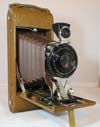
1925 Features : Real leather dyed golden brown; Leather pimpled to resemble ostrich skin; Line detailing in body leather; Quality chrome focus sliders; Chrome lens plate; Matching brown bellows; Ornate chrome film winder; Chrome detailing on viewfinder; Stippled gold table stand with manufacturers name; Chrome film door lock; Concentric circles on film spool pins.
Agfa-Ansco Royal 1A
Rajar No.6
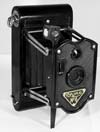
1929 Features: Built almost exclusively of Bakelite; Decorative line mouldings to Bakelite body; Decorative cross-hatch mouldings to Bakelite lens plate.; Chrome used on struts; Chrome used on film advance key; Triangular name plate with chrome Deco lettering; Concentric stepped circles on lens bezel.
Rajar No.6
Kodak Petite Lightning
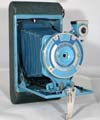
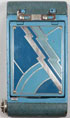
1930 Features : Designed by Walter Dorwin Teague; Lightning Bolt design on base plate.; Blue and chrome geometric design on lens plate; Smooth covering material with diamond pattern on body; Chrome struts and film door lock; Chrome winder, viewfinder bezel and table stand.
Kodak Petite Lightning
Kodak Beau Brownie
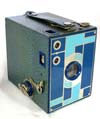
1930 Features: Designed by Walter Dorwin Teague; Geometric design to front pane; Chrome and enamel used; Decorative case latches; Octagonal plate around winder; Patterned and coloured leatherette to match with decorative front panel; Matching leatherette on handle.
Kodak Beau Brownie
Kodak Hawkette
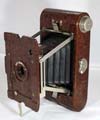
1930 Features: Moulded Bakelite body; Brown marbled Bakelite; Multi-line pattern in Bakelite; Chrome struts; Chrome film advance; Chrome back closing lock.
Kodak Hawkette
No 1A Gift Kodak
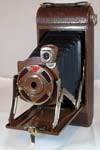
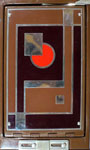
1930 Features: Designed by Walter Dorwin Teague; Interlocking geometric shapes in black, brown, silver, and red on lens plate; Interlocking geometric shapes in black,
brown, silver, and red on base plate; Brown leatherette to match body; Chrome struts and film door lock; Chrome winder and table stand.
No 1A Gift Kodak
Jiffy Kodak Six 20
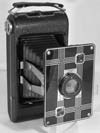
1933 Features: Designed by Walter Dorwin Teague; Etched metal front panel with lined geometric design.; Chrome plated and enamel used for front panel; Symmetrical design; Chrome embellishment used throughout.
Jiffy Kodak Six 20
Soho Pilot
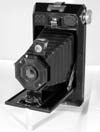
1933 Features: Moulded Bakelite body; Basket weave patterning on Bakelite; Octagonal face plate; Concentric octagons on face plate; Sunburst motif surrounding red window on rear; Chrome back closing lock; Chrome winding knob with concentric circles; Chrome table stand; Chrome bezel around red window.
Soho Pilot
Zeiss Ikon Ikoflex I
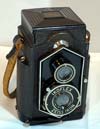
1934 Features: Hexagonal shutter plate; Shutter plate in chrome and black enamel; Body has stepped design; Viewfinder cover has stepped design (Ziggurat style); Chrome embellishments; Decorative concentric circles on lens plate; Decorative concentric circles around viewfinder lens.
Zeiss Ikon Ikoflex I
Streamline Moderne
Streamline Moderne, sometimes termed Art Moderne, is a late type of the Art Deco design style that emerged in the 1930s in America and continued into the 1940s. Its style emphasized curving forms, smooth & polished surfaces and long horizontal lines. Art Deco and Streamline Moderne were not opposites. Streamline Moderne cameras with Deco elements were not uncommon.
Ebner 6x9
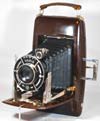
1934 Features: Moulded Brown Marbled Bakelite body; Streamline Moderne Style; Leather patterning on Bakelite; Chrome struts; Chrome table stand and handle fixings; Chrome pop-up finder;
Chrome bezel around viewfinder.
Ebner 6x9
Eastman Kodak Bullet
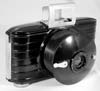
1936 Features: Designed by Walter Dorwin Teague; Streamline Moderne design; Curvilinear shape; Bakelite body with linear raised horizontal striped pattern; Aluminium winder and pop-up finder.
Eastman Kodak Bullet
Kodak Bantam Special
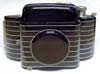
1936 Features: The Kodak Bantam Special may be one of the most uniquely beautiful cameras of all time. Designed by Walter Dorwin Teague; Art Deco Streamline Moderne design; Aluminium clam shell case made using cast aluminium and black enamel; Horizontal lines and curved body enhancing the streamline effect; Chrome film advance knob.
Kodak Bantam Special
Roto Elvo
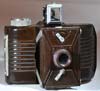
1938 Features: Art Deco Streamline Moderne design; Curvilinear body design; Bakelite body; Horizontal ribbing to Bakelite; Art Deco lettering of name on body; Trapisoidal moulding on lens faceplate; Chrome film advance knob.
Roto Elvo
Art Deco in the 40s
By the 1940's Art Deco as a movement was coming to an end. But all Art Deco designers didn't just disappear in 1940 as if struck down by some plague. During the war, camera production in Europe virtually came to a halt. After World War II the style had largely vanished, except in industrial design, where it continued to be used in automobile styling and products such as juke boxes. In the late 40's, many camera makers simply started up again with the pre-war Art Deco designs and therefore continued to produce cameras with features reminiscent of the Art Deco period.
Ilford Craftsman
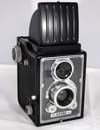
1949 Features: Produced after the main Art Deco period; Vertical stripe to front panel; Chrome plated and enamel used for front panel; Chrome case latch; Bright chrome detailing on viewfinder and knobs; Ribbed design on viewfinder cover; Raised concentric circles in Bakelite around knobs; Symmetrical layout to front.
Ilford Craftsman
Indra Lux
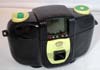
1949 Features: Designed after the main Art Deco period; Bakelite look-a-like plastic body; Steamlined Curvilinear shape; Wing-like horizontal steps surrounding camera body; Optical finder with vertical ribbed pattern surround; Film winder and shutter release in white plastic with green highlights; Horizontal bars on white shield shaped lens surround; Art Deco lettering on lens surround
Indra Lux