Ciro Ciro-flex E
Specification
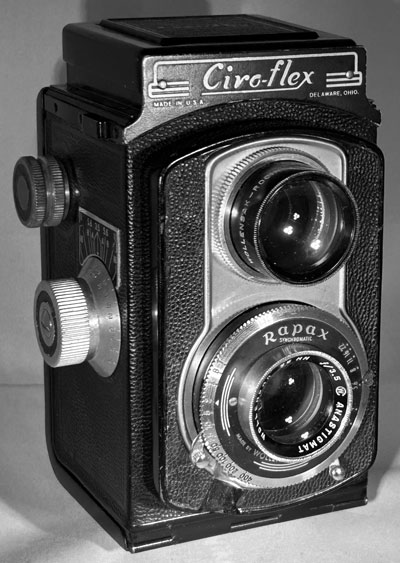
Model E
| Manufacturer | : | Ciro |
|---|---|---|
| Produced | : | 1947 |
| Classification | : | Medium Format |
| Body Type | : | Twin lens reflex |
| Construction | : | Metal |
| Film Type | : | 120 |
| Film Width | : | 62mm |
| Image Size | : | 6 x 6 cm |
| No. of Images | : | 12 |
| Lens Type | : | Wallensak Anastigmat |
| Focal Length | : | 85mm |
| Focus Type | : | Variable |
| Focal Range | : | 3ft - inf. |
| Aperture Type | : | Iris |
| Apertures | : | f/3.5 - f/22 |
| Shutter Type | : | Rapax Synchromatic |
| Shutter Speeds | : | T, B, I(1/400s - 1s) |
| Size Open (w x h x d) | : | 95 x 200 x 115 mm |
| Size Closed (w x h x d) | : | 95 x 150 x 115 mm |
| Weight | : | 663g |
| Serial Number | : | 85958 |
Description
This Ciro-flex is one of a series of 6x6 TLRs made by the American manufacturer Ciro beginning circa 1941. All are of similar appearance and operation.
- Ciro-flex Model A, made in Detroit with Wollensak 85/3.5 triplet lens.
- Ciro-flex Model B with Alphax shutter, made in Detroit and then Delaware OH.
- Ciro-flex Model C with Rapax shutter.
- Ciro-flex Model D with Alphax synchromatic shutter.
- Ciro-flex Model E with Rapax synchromatic shutter.
- Ciro-flex Model F with an f/3.2, four-element Wollensak Raptar 83mm lens and Rapax Full Synchromatic shutter.
The focal length of 85mm makes for adequate sharpness in the corners of the 2¼” x 2¼” image. A red window with a cover is used to advance to the next frame. The large viewfinder lens (f/3.5) produces a bright image on the ground glass screen. There is a magnifying glass that can be flipped into place to check focussing. The front of the viewfinder also drops down to produce a simple 'sports finder'.
A large knob on the right hand side of the camera is used for focussing. When this is turned, a plate that supports the main lens and the viewfinder lens moves forward and backward to achieve focus. The focus dial has markings indicating the depth of field for various aperture settings. It can focus between 3ft and infinity. The aperture range is f/3.5 to f/22.
The Rapax Synchomatic shutter is capable of shutter speeds varying from 1/400s down to 1s. The shutter has to be set before it is released. The shutter release is not coupled to the frame advance, so double exposure is possible. It has a cable release socket.
The camera supports flash photos with a socket on the side for synchronization.
There are tripod mounts for both portrait and landscape photos.
How to Use
The user manual is found here:- Ciro-flex ManualThe highest speed (1/400s) is probably no longer accurate and may run slow. This would lead to overexposure.
If you don't want to bother with an exposure meter, follow the guide shown. It is based on the 'Sunny 16' rule. Film is so forgiving and will produce acceptable results even when overexposed by 2 or 3 stops or underexposed by 1 stop.
Remember that the exposure guide in the camera user manual may not be helpful as it is based on the use of old film with a low ISO value.
The tables assume that the sun is at least 30 degrees above the horizon - that's 10am - 5pm on a summer's day in the UK.
If you are not sure about the light level, err on the side of overexposure - i.e. assume the smaller f number.
Where there is a choice, a larger f number will give a larger depth of field.
For the slower speeds, you may need a tripod to stop blur through shake.
Using ISO 100/125 film
| Weather Conditions | Shadow Detail | Shutter Speed (s) | ||
|---|---|---|---|---|
| 1/50 | 1/100 | 1/200 | ||
 Sunny SunnySnow/Sand | Dark with sharp edges | - | f/22 | f/16 |
| Sunny | Distinct | f/22 | f/16 | f/11 |
 Slight Overcast Slight Overcast | Soft around edges | f/16 | f/11 | f/8 |
 Overcast Overcast | Barely visible | f/11 | f/8 | f/5.6 |
 Heavy Overcast Heavy Overcast | None | f/8 | f/5.6 | f/4 |
 Open Shade Open Shade/Sunset | None | f/5.6 | f/4 | f/3.5 |