Voigtländer Brilliant
Specification
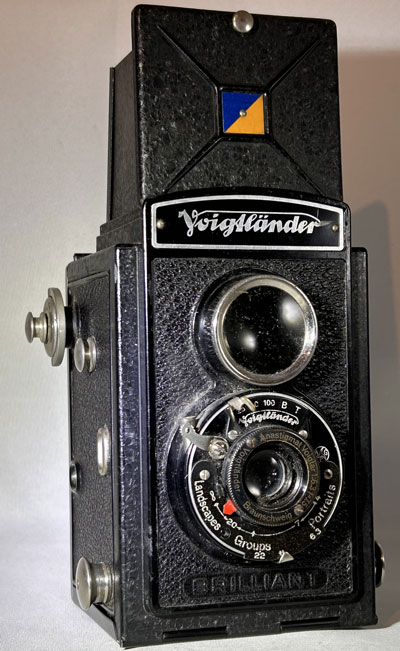
| Manufacturer | : | Voigtländer |
|---|---|---|
| Produced | : | 1932 |
| Classification | : | Medium Format |
| Body Type | : | Pseudo Twin Lens Reflex |
| Construction | : | Metal |
| Film Type | : | 120 |
| Film Width | : | 62mm |
| Image Size | : | 6 x 6 cm |
| No. of Images | : | 12 |
| Lens Type | : | Voigtar Anastigmat |
| Aperture Type | : | Iris |
| Apertures | : | f/3.6 - f/22 |
| Focus Type | : | Variable |
| Focal Length | : | 75mm |
| Focal Range | : | 4ft - inf. |
| Shutter Type | : | Leaf |
| Shutter Speeds | : | T,B, I(1/25s, 1/50s, 1/100s) |
| Size Open (w x h x d) | : | 95 x 168 x 90 mm |
| Size Closed (w x h x d) | : | 95 x 120 x 90 mm |
| Weight | : | 545g |
Art Deco Credentials

Acceptable: Modest and restricted
- produced during the main Art Deco period
- geometrical pattern on viewfinder cover
- coloured logo on viewfinder cover
- chrome highlights
Description
The Voigtländer Brilliant is a range of mainly pseudo-TLR cameras that function more like box cameras. They take 12 6×6 cm exposures on 120 film.
The first 1932 version of the Brilliant, described here, has a metal body. From 1937, Brilliants were made of Bakelite. The Bakelite version was known as the Brilliant V6. A later model called the Brilliant Focussing V6 was a true TLR camera.
This camera has a large waist level brilliant viewfinder on the top of the camera.
Focus can be varied between 4ft and infinity using a front focussing lens. The focussing scale is also annotated for Landscapes, Groups and Portraits
A range of shutter speeds are available including T,B and I(1/25s, 1/50s, 1/100s). There is a threaded connector for the attachment of a remote cable release.
The lens has a variable iris type aperture ranging from f/6.3 to f/22. It is annotated at f/6.3, f/11 and f/22.
The camera has an automatic frame counter. The red window on the base is only used to line up the first frame. Subsequently, the camera transport system uses a small window in the side that shows the current frame number. This is particularly useful with modern film because of the sensitivity to light through the red window. Once the first frame has been selected using the red window, it should be covered with black tape for the rest of the frames. Once you have taken all of the frames, a switch on the side allows the counter to return to frame 1.
The camera has a single tripod mount on the base.
How to Use
Shutter speeds available are 1/25s, 1/50s, 1/100s. The aperture range is f/6.3 to f/22, annotated at f/6.3, f/11 and f/22. For f/16 choose half way between f/22 and f/11. For f/8 choose half way between f/11 and f/6.3.
If you don't want to bother with an exposure meter, follow the guide shown. It is based on the 'Sunny 16' rule. Film is so forgiving and will produce acceptable results even when overexposed by 2 or 3 stops or underexposed by 1 stop.
Remember that the exposure guide in the camera user manual may not be helpful as it is based on the use of old film with a low ISO value.
The tables assume that the sun is at least 30 degrees above the horizon - that's 10am - 5pm on a summer's day in the UK.
If you are not sure about the light level, err on the side of overexposure - i.e. assume the smaller f number.
Where there is a choice, a larger f number will give a larger depth of field.
For the slower speeds, you may need a tripod to stop blur through shake.
Using ISO 100/125 film
| Weather Conditions | Shadow Detail | Shutter Speed (s) | ||
|---|---|---|---|---|
| 1/25 | 1/50 | 1/100 | ||
 Sunny SunnySnow/Sand | Dark with sharp edges | - | - | f/22 |
| Sunny | Distinct | - | f/22 | f/16 |
 Slight Overcast Slight Overcast | Soft around edges | f/22 | f/16 | f/11 |
 Overcast Overcast | Barely visible | f/16 | f/11 | f/8 |
 Heavy Overcast Heavy Overcast | None | f/11 | f/8 | f/6.3 |
 Open Shade Open Shade/Sunset | None | f/8 | f/6.3 | - |