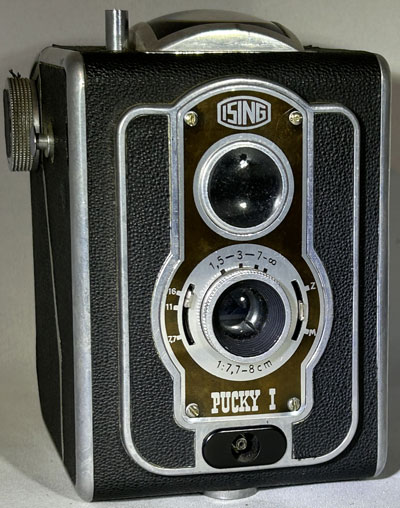
Ising Pucky I
Specification
| Manufacturer | : | Ising |
|---|---|---|
| Produced | : | 1950-1954 |
| Classification | : | Medium Format |
| Body Type | : | Pseudo Twin Lens Reflex |
| Construction | : | Aluminium |
| Film Type | : | 120 |
| Film Width | : | 62mm |
| Image Size | : | 2¼ x2 ¼ in |
| No. of Images | : | 12 |
| Lens Type | : | meniscus |
| Focal Length | : | 80mm |
| Focus Type | : | Variable |
| Focus Range | : | 1.5m to inf |
| Aperture Type | : | Rectangle Iris |
| Aperture | : | f/7.7 - f/16 |
| Shutter Type | : | leaf |
| Shutter Speeds | : | Z(Bulb), M(Instant)1/100s |
| Size (w x h x d) | : | 95 x 120 x 90 mm |
| Weight | : | 620g |
Art Deco Credentials

Acceptable: Modest and restricted
- Produced after the main Art Deco period
- Decorative front panel
- Symetrical layout to front.
- Streamline Modern design.
- Aluminium detailing on the box edges
Description
The Ising Pucky I has an aluminium body with a leather-grain patterned covering.
It is described as a pseudo twin lens reflex camera. It isn't a true TLR because the top lens is just part of the viewfinder and does not aid focussing. The viewfinder is large and easy to use.
The camera can be focussed between 1.5 m and infinity. A sliding lever on the front can vary the rectangular aperture between f/7.7 and f/16 with markings at f/7.7, f/11 and f/16
The shutter can be set to Instant(M) or Bulb(Z) using another lever on the front. There is a lock to prevent double exposure. The film must be turned on before the shutter will fire again. Flash synchronisation is provided using a connector on the front at the bottom.
There is a red window with a sliding sprung cover on the back.
How to Use
This camera takes 120 film which is easily available.
As the shutter speed is only 1/100s, it is advisable to use a tripod to get clear shake free images. However, holding it against a wall or other solid object would work as well. For quick snapshots, hold it firmly against your body. The film should be turn on in subdued light because modern film is sensitive to red light.
If you don't want to bother with an exposure meter, follow the guide shown. It is based on the 'Sunny 16' rule. Film is so forgiving and will produce acceptable results even when overexposed by 2 or 3 stops or underexposed by 1 stop.
The tables assume that the sun is at least 30 degrees above the horizon - that's 10am - 5pm on a summers day (May - August) in the UK.
Remember that the exposure guide in the manual may not be helpful as it is based on the use of old film with a low ISO value.
Using ISO 100/125 film - shutter speed 1/100s
| Weather Conditions | Shadow Detail | Aperture | Exposure |
|---|---|---|---|
 Sunny SunnySnow/Sand | Dark with sharp edges | f/16 | +1 Stops Overexposed Acceptable |
| Sunny | Distinct | f/16 | Good |
 Slight Overcast Slight Overcast | Soft around edges | f/11 | Good |
 Overcast Overcast | Barely visible | f/7.7 | Good |
 Heavy Overcast Heavy Overcast | None | f/7.7 | -1 Stop Underexposed Acceptable |
 Open Shade Open Shade/Sunset | None | f/7.7 | -2 Stops Underexposed Not Acceptable |