Foth 6x9
Specification
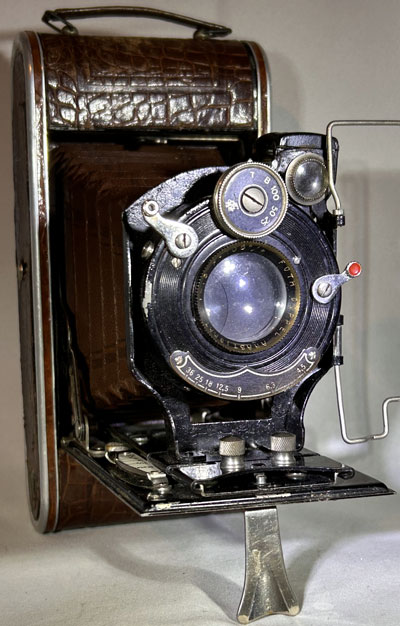
| Manufacturer | : | Foth |
|---|---|---|
| Produced | : | 1927 |
| Classification | : | Medium Format |
| Body Type | : | Folding Bed |
| Bellows Deployment | : | Sliding Rail |
| Construction | : | Metal |
| Film Type | : | 120 |
| Film Width | : | 62mm |
| ImageSize | : | 2¼ x 3¼ in |
| No. of Images | : | 8 |
| Lens Type | : | Foth Doppel Anastigmat |
| Focus Type | : | Variable |
| Focal Length | : | 105mm |
| Focal Range | : | 1.5m - inf |
| Aperture Type | : | Iris |
| Aperture | : | f/4.5 - f/36 |
| Shutter Type | : | Leaf |
| Shutter Speeds | : | T,B, I(1/25 - 1/100 sec) |
| Size Closed (w x h x d) | : | 90 x 170 x 35 mm |
| Size Open (w x h x d) | : | 90 x 170 x 135 mm |
| Weight | : | 600g |
Art Deco Credentials

Acceptable: Modest and restricted
- Produced during the main Art Deco period;
- Imitation brown crocodile skin covering;
- Embossed detailing on crocodile skin;
- Brown bellows with embossed lines
- Polished metal detailing on edges;
- Chrome highlights;
Description
The Foth 6x9 Roll film camera was manufactured by F.C. Foth & Co. from 1927 to the 1940s. The camera body and bed are metal and the bellows are leather. It is capable of capturing 2¼ x 3¼ inch (6x9cm) exposures on standard 120 roll film. The bellows are extended by pulling two knobs along a sliding rail. In addition to the existing brilliant finder, a wire frame finder was also introduced in 1931.
It initially had a Foth Doppel Anastigmat f/6.3 lens. A deluxe model in brown with imitation crocodile skin covering, shown here, has a faster Foth Doppel Anastigmat f/4.5 (1927-34). You may even see a green version but it is very rare. The aperture control lever is annotated at f/4.5, f/6.3, f/9, f/12.5, f/18 f/25 and f/36.
The Foth Shutter provides speeds of 1/25s, 1/50s and 1/100s as well as 'T' and 'B'. The shutter also has a connection for a remote cable release. A delay timer is provided.
The brilliant viewfinder rotates on the lens standard and can be adjusted for both portrait and landscape images. A wire frame finder was also introduced in 1931.
A lever on the sliding bed allows the focus to be changed from 1.5 m to infinity. The lever extends the bellows to get closer focus.
There are two tripod mount for portrait and landscape mode. The red window does not have a cover.
How to Use
This camera can take 120 film which easily available from photographic outlets.
If you don't want to bother with an exposure meter, follow the guide shown. It is based on the 'Sunny 16' rule. Film is so forgiving and will produce acceptable results even when overexposed by 1 or 2 stops or underexposed by 1 stop.
Remember that the exposure guide in the camera user manual may not be helpful as it is based on the use of old film with a low ISO value.
The tables assume that the sun is at least 30 degrees above the horizon - that's 10am - 5pm on a summer's day (May-August) in the UK.
If you are not sure about the light level, err on the side of overexposure - i.e. assume the smaller f number.
Where there is a choice, a larger f number will give a larger depth of field.
For the slower speeds, you may need a tripod to stop blur through shake.
The red window should be kept covered with non-transparent tape except when winding on in subdued light.
Using ISO 100/125
Key: Green - Good exposure; Amber - acceptable exposure. Number of stops over.
| Weather Conditions | Shadow Detail | Shutter Speed (s) | ||
|---|---|---|---|---|
| 1/25 | 1/50 | 1/100 | ||
 Sunny SunnySnow/Sand | Dark with sharp edges | f/36 +1 | f/36 | f/25 |
| Sunny | Distinct | f/36 | f/25 | f/18 |
 Slight Overcast Slight Overcast | Soft around edges | f/25 | f/18 | f/12.5 |
 Overcast Overcast | Barely visible | f/18 | f/12.5 | f/9 |
 Heavy Overcast Heavy Overcast | None | f/12.5 | f/9 | f/6.3 |
 Open Shade Open Shade/Sunset | None | f/9 | f/6.3 | f/4.5 |