Coronet Clipper
Specification
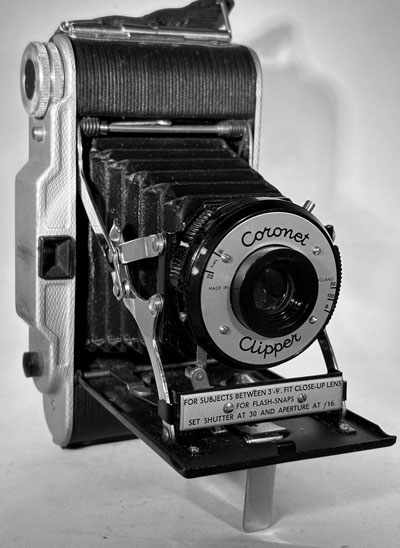
| Manufacturer | : | Coronet |
|---|---|---|
| Produced | : | 1956 |
| Classification | : | Medium Format |
| Body Type | : | Folding Bed |
| Bellows Deployment | : | Self Erecting |
| Construction | : | Metal |
| Film Type | : | 120 |
| Film Width | : | 62mm |
| Image Size | : | 2¼ x 3¼ |
| No. of Images | : | 8 |
| Lens Type | : | Meniscus |
| Focal Length | : | 100mm |
| Focus Type | : | Fixed |
| Focal Range | : | 6ft to inf. |
| Aperture Type | : | 2 holes |
| Apertures | : | f/16 and f/22 |
| Shutter Type | : | Everset scissor |
| Shutter Speeds | : | B, 1/30s, 1/100s |
| Size Open (w x h x d) | : | 90 x 165 x 124 mm |
| Size Closed (w x h x d) | : | 90 x 165 x 35 mm |
| Weight | : | 532g |
Art Deco Credentials

Acceptable: Modest and restricted
- Produced after the main Art Deco period.
- Grey metallic shutter plate.
- Chrome used on complex curvilinear struts
- Aluminium top and bottom plates with small diamond shaped embossing
- Stylised bottom plate with ruled lines and diamond
- Embossed chevron pattern on covering
- Alloy winder knob
- Chrome table stand
- Chrome film door latch
Description
This is a self erecting bellows camera manufactured in Aston, Birmingham, Great Britain around 1959 by Coronet Camera Co. This Coronet Clipper is a metal camera with the body covered in imitation leather. The metal top and bottom are particularly attractive. It uses 120 film producing a 6x9 cm negative. The camera is opened by pressing a button on the upper right side of the body which allows the front to fold out extending the bellows.
It has a simple meniscus lens with two apertures of f/16 and f/22. The lens is fixed focus with a range from 6 feet to infinity. It has a simple scissor shutter with speeds of 1/30 and 1/100 seconds plus B. The shutter release is mounted on the body.
A slide on one side of the lens plate selects the speed whilst a slide on the other selects the aperture. The optical viewer is fixed on the body and is used for both portrait and landscape orientation. The film advance knob is not coupled to the shutter release and is used in conjunction with a red window to advance exposures. The red window has a sliding cover. To replace the roll film, the back cover is opened by sliding a catch located under the handle.
It has a flash connector on the lens plate.
How to Use
This camera takes 120 film which is readily available. The red window should be kept covered except when advancing the film.
Shutter speeds available are 1/30s and 1/100s. Apertures are f/16 and f/22.
If you don't want to bother with an exposure meter, follow the guide shown. It is based on the 'Sunny 16' rule. Film is so forgiving and will produce acceptable results even when overexposed by 2 or 3 stops or underexposed by 1 stop.
Remember that the exposure guide in the camera user manual may not be helpful as it is based on the use of old film with a low ISO value.
The tables assume that the sun is at least 30 degrees above the horizon - that's 10am - 5pm on a summer's day (May to August) in the UK.
If you are not sure about the light level, err on the side of overexposure - i.e. assume the smaller f number.
Where there is a choice, a larger f number will give a larger depth of field.
For the 1/30 speed, I recommend a tripod to stop blur through shake. Or hold it against a wall or other solid object.
Using ISO 100/125
Key: Green - Good exposure; Amber - acceptable exposure; Red - unacceptable exposure. Number of stops over or under shown.
| Weather Conditions | Shadow Detail | Shutter Speed (s) | |
|---|---|---|---|
| 1/30 | 1/100 | ||
 Sunny SunnySnow/Sand | Dark with sharp edges | f/22 +2 over | f/22 |
| Sunny | Distinct | f/22 +1 over | f/16 |
 Slight Overcast Slight Overcast | Soft around edges | f/22 | f/16 -1 under |
 Overcast Overcast | Barely visible | f/16 | f/16 -2 under |