ATOMS Aiglon
Specification
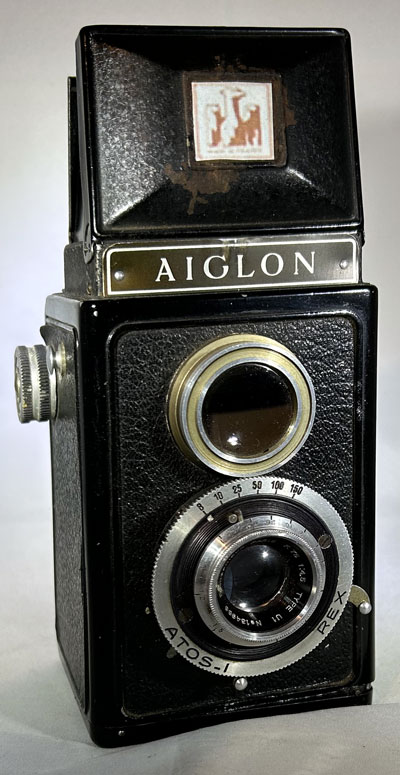
| Manufacturer | : | ATOMS |
|---|---|---|
| Produced | : | 1948 |
| Classification | : | Medium Format |
| Body Type | : | Pseudo Twin Lens Reflex |
| Construction | : | Metal |
| Film Type | : | 120 |
| Film Width | : | 62mm |
| ImageSize | : | 5.5 x 5.5 cm |
| No. of Images | : | 12 |
| Lens Type | : | P.Angénieux 4.5 Type U1 |
| Focal Length | : | 75mm |
| Focus Type | : | Variable |
| Focal Range | : | 1m - inf. |
| Aperture Type | : | Iris |
| Aperture | : | f/4.5 - f/16 |
| Shutter Type | : | Leaf |
| Shutter Speeds | : | B, I(1/10, 1/25s, 1/50s, 1/100s, 1/150s) |
| Size Open(w x h x d) | : | 82 x 175 x 95 mm |
| Size Closed(w x h x d) | : | 82 x 135 x 95 mm |
| Weight | : | 584g |
Art Deco Credentials

Acceptable: Modest and restricted
- Produced after the main Art Deco period.
- Metal body with leatherette covering.
- ATMOS logo embossed in rear cover with sunrise motif
- Satin aluminium highlights.
- Viewfinder cover with pyramid design.
- Eaglet emblem on viewfinder cover.
Description
The ATOMS Aiglon (Eaglet) is a nominal 6x6cm camera which has a metal body. The Aiglon gets its name from the coat of arms where it is manufactured. It can be described as a pseudo twin lens reflex camera. It isn't a true TLR because the top lens is just part of the viewfinder and does not aid focussing. It is covered in leatherette. The camera has a folding hood with an oversized brilliant finder.
The taking lens is a 75mm P.Angénieux 4.5 Type U1. The focus is changed by screwing out the front lens. The multiblade iris allows the aperture to be changed giving a range of aperture sizes from f/4.5 to f/16.
The shutter is primed using a lever at the bottom of the lens and released by a separate lever. It has a mechanical remote release connector.
The back of the camera can be removed for film loading by a sliding lock on the top of the camera. The red window can be closed using a rotating shutter. There is a thread for a tripod on the bottom of the camera.
How to Use
This camera takes 120 film which is easily available from most photographic outlets.
If you don't want to bother with an exposure meter, follow the guide shown. It is based on the 'Sunny 16' rule. Film is so forgiving and will produce acceptable results even when overexposed by 2 or 3 stops or underexposed by 1 stop.
Remember that the exposure guide in the camera user manual may not be helpful as it is based on the use of old film with a low ISO value.
The tables assume that the sun is at least 30 degrees above the horizon - that's 10am - 5pm on a summer's day (May to August) in the UK.
If you are not sure about the light level, err on the side of overexposure - i.e. assume the smaller f number.
Where there is a choice, a larger f number will give a larger depth of field.
For the slower speeds (<1/100s), you may need a tripod to stop blur through shake.
Using ISO 100/125
| Weather Conditions | Shadow Detail | Shutter Speed (s) | |||
|---|---|---|---|---|---|
| 1/25 | 1/50 | 1/100 | 1/150 | ||
 Sunny SunnySnow/Sand | Dark with sharp edges | - | - | - | f/16 |
| Sunny | Distinct | - | - | f/16 | f/11 |
 Slight Overcast Slight Overcast | Soft around edges | - | f/16 | f/11 | f/8 |
 Overcast Overcast | Barely visible | f/16 | f/11 | f/8 | f/5.6 |
 Heavy Overcast Heavy Overcast | None | f/11 | f/8 | f/5.6 | f/4.5 |
 Open Shade Open Shade/Sunset | None | f/8 | f/5.6 | f/4.5 | - |