Wirgin Presto
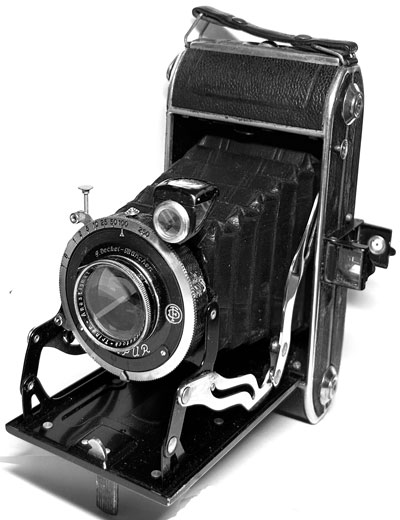
Art Deco Credentials ⓘ

Bold, geometric cameras from Deco’s golden age


Significant: Strong and recognisable Deco features
- Produced during the main Art Deco period.
- Geometric pattern in chrome on black enamel on faceplate.
- Curvilinear body design with chrome edge highlighting.
- Leatherette with embossed lined pattern on top and bottom.
- Sides are embossed with lines and small diamonds
- Chrome and black enamel brilliant finder.
- Ornate chrome double‑knee struts.
- Ornate chrome winder and film door latch.
- Chrome table stand, tripod sockets and red window bezels.
Specification
| Manufacturer | : | Wirgin |
|---|---|---|
| Produced | : | 1933 |
| Classification | : | Medium Format |
| Body Type | : | Folding Bed |
| Bellows Deployment | : | Self Erecting |
| Construction | : | Metal |
| Film Type | : | 120 |
| Film Width | : | 62mm |
| ImageSize | : | 6 x 9 cm / 6 x 4.5 cm |
| No. of Images | : | 8/16 |
| Lens Type | : | Rodenstock Trinar Anastigmat |
| Focal Length | : | 105mm |
| Focus Type | : | Variable |
| Focal Range | : | 1.5m - inf. |
| Aperture Type | : | Iris |
| Aperture | : | f/3.8 - f/25 |
| Shutter Type | : | Rim‑set Compur leaf shutter |
| Shutter Speeds | : | T,B,1,1/2,1/5,1/10,1/25,1/50,1/100,1/250 sec |
| Size Closed (w x h x d) | : | 90 x 170 x 35 mm |
| Size Open (w x h x d) | : | 102 x 170 x 135 mm |
| Weight | : | 636g |
Description
The Wirgin Presto is a folding camera made in the 1930s. It is the higher-end sibling of the Auta — not just a variant, but a more premium model. The camera is self-erecting, with a button to release the front next to the frame viewfinder. It takes eight 6 x 9 cm or 16 6 x 4.5 cm images on 120 roll film. A mask(usually lost) is used to reduce the frame to 6 x 4.5cm .
The main viewfinder is a double frame type. It has a flip‑up half‑frame finder mask. There is also a brilliant finder mounted on the lens standard, which swivels for horizontal and vertical use. There is a sliding button on the back which controls a covers for the 2 red windows. The film compartment opens with a small sliding latch, marked with an arrow, under the carrying strap. The camera has two 1/4 inch tripod mounts.
The lens is a 10.5 cm, f/3.8 Rodenstock lens. Focus is by turning the front lens mount. The focus is adjustable down to 1.5m.
It has a rim‑set Compur leaf shutter with speeds from 1s - 1/250s, plus 'B' and 'T'. There is a shutter release push rod on the lens standard. It also has a connection for a remote cable release. There is also the facility to delay the shot. A sliding button on the top of the shutter allows the delay function to be activated.

Get a camera like this from Ebay - Wirgin Presto
How to Use
Shutter speeds are range from 1s - 1/250s although the accuracy is not guaranteed. The aperture range is f/3.8 to f/25, annotated at 1/3.8, 1/4.5, 1/6.3, 1/9, 1/12.5, 1/18 and 1/25.
If you don't want to bother with an exposure meter, follow the guide shown. It is based on the 'Sunny 16' rule. Film is so forgiving and will produce acceptable results even when overexposed by 2 or 3 stops or underexposed by 1 stop.
Remember that the exposure guide in the camera user manual may not be helpful as it is based on the use of old film with a low ISO value.
The tables assume that the sun is at least 30 degrees above the horizon - that's 10am - 5pm on a summer's day in the UK.
If you are not sure about the light level, err on the side of overexposure - i.e. assume the smaller f number.
Where there is a choice, a larger f number will give a larger depth of field.
For the slower speeds, you may need a tripod to stop blur through shake.
The results shown in green show perfect exposure. The results shown in amber will give acceptable results. Results in red are unacceptable.
Using ISO 100/125 film
| Weather Conditions | Shadow Detail | Shutter Speed (s) | ||
|---|---|---|---|---|
| 1/25 | 1/50 | 1/100 | ||
 Sunny SunnySnow/Sand | Dark with sharp edges | f/25 | f/25 | f/25 |
| Sunny | Distinct | f/25 | f/25 | f/18 |
 Slight Overcast Slight Overcast | Soft around edges | f/25 | f/18 | f/12.5 |
 Overcast Overcast | Barely visible | f/18 | f/12.5 | f/9 |
 Heavy Overcast Heavy Overcast | None | f/12.5 | f/9 | f/6.3 |
 Open Shade Open Shade/Sunset | None | f/9 | f/6.3 | f/3.8 |
Get Film for this camera from Ebay - 120 film