Utility Falcon Junior
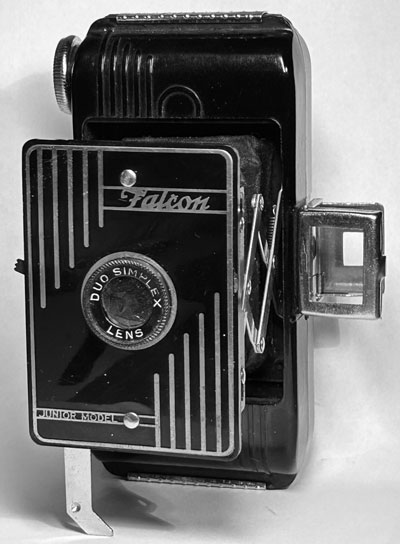
Art Deco Credentials ⓘ

Flowing forms inspired by speed and modernity

Iconic: Defining and celebrated Art Deco design
- produced during the main Art Deco period
- Art Deco Streamline Moderne design
- Bakelite body
- linear raised striped pattern on Bakelite front
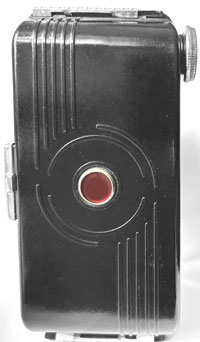
- linear raised striped and circular pattern on Bakelite rear
- chrome struts, viewfinder, table stand and latches for the back
- chrome plated winder
- linear striped pattern on metal faceplate
- curved body enhancing the streamline effect
Specification
| Manufacturer | : | Utility |
|---|---|---|
| Produced | : | 1939 |
| Classification | : | Medium Format |
| Body Type | : | Folding Strut |
| Construction | : | Bakelite |
| Film Type | : | 127 |
| Film Width | : | 46mm |
| ImageSize | : | 1⅝ x 2½ in |
| No. of Images | : | 8 |
| Lens Type | : | Duo Simplex |
| Focus Type | : | Fixed |
| Focal Length | : | 70mm |
| Focal Range | : | 6ft - inf. |
| Aperture Type | : | Multihole |
| Aperture | : | f/16 and f/22 |
| Shutter Type | : | Guillotine |
| Shutter Speeds | : | T, I*(1/50) sec |
| Size Closed (w x h x d) | : | 63 x 140 x 32 mm |
| Size Open (w x h x d) | : | 92 x 140 x 83 mm |
| Weight | : | 241g |
| * Measured on this camera | ||
Description
The Falcon Junior Camera was manufactured by the Utility Camera Corp. of Chicago, Illinois from 1939. It was designed to be an inexpensive and simple to operate camera. It is capable of capturing eight 1⅝ x 2½ inch (4.5 x 6cm) exposures on standard No. 127 roll film in colour or black-and-white. It is constructed of Bakelite with a folding metal viewfinder. The metal lens plate folds out on struts when the release button is pressed.
It has a simple T/I shutter for both snapshots and time exposure. A tab behind the faceplate can be pulled out for Instantaneous or pushed in the Time exposures. It has a fold out table stand for time exposures.
The f/16 Duo Simplex can be stopped down to f/22 by shifting a lever behind the faceplate. The red window is not covered.
It was available in a variety of colours with two different art-deco face plate patterns.

Get a camera like this from Ebay - Utility Falcon Junior
How to Use
This camera is identical in operation to the Spartus Folding Camera found here.
This camera takes 127 film which is still available from select outlets - search for 'Rera Pan 100-127' which is a black & white film. For those photographers in the UK, try Nick & Trick photographic services. If you want to use a particular type of film which is not available commercially, then you can cut your own 127 film from any 120 film. See my page on 'How to cut 127 film from 120 film'.
If you don't want to bother with an exposure meter, follow the guide shown. It is based on the 'Sunny 16' rule. Film is so forgiving and will produce acceptable results even when overexposed by 2 or 3 stops or underexposed by 1 stop.
Remember that the exposure guide in the camera user manual may not be helpful as it is based on the use of old film with a low ISO value.
The table assumes that the sun is at least 30 degrees above the horizon - that's 10am - 5pm on a summer's day in the UK.
This camera has a choice of two aperture values - f/16 and f/22(with mask in place). The shutter speed is 1/50s
If you are not sure about the light level, err on the side of overexposure - i.e. assume the smaller f number.
Modern films are sensitive to red light. Make sure you cover the red window with black tape and only open it to wind on in low light.
You may want to use a tripod to stop blur through shake.
Using ISO 100/125 film - shutter speed 1/50s
| Weather Conditions | Shadow Detail | Aperture | Exposure |
|---|---|---|---|
 Sunny SunnySnow/Sand | Dark with sharp edges | f/22 | +1 Stop Overexposed Acceptable |
| Sunny | Distinct | f/22 | Good |
 Slight Overcast Slight Overcast | Soft around edges | f/16 | Good |
 Overcast Overcast | Barely visible | f/16 | -1 Stop Underexposed Acceptable |
 Heavy Overcast Heavy Overcast | None | f/16 | -2 Stops Underexposed Not Acceptable |
 Open Shade Open Shade/Sunset | None | f/16 | -3 Stops Underexposed Not Acceptable |
Get Film for this camera from Ebay - 127 film