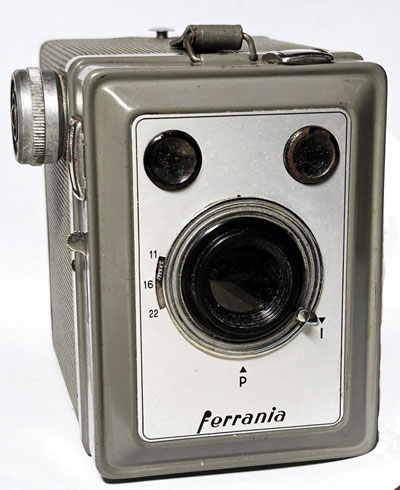
Ferrania Zeta Duplex 2
Art Deco Credentials ⓘ

Subtle elements of Art Deco appear without fully shaping the design


Modest: Subtle and restrained Deco influence
- Produced after the main Art Deco period;
- Ribbed circular chrome escutcheon around lens;
- Moulded front of the box enclosure;
- Moulded back of the box enclosure;
- Chrome border around the viewfinders;
- Chrome on strap fixing and opening button.
- Chevron pattern on box covering.
Specification
| Manufacturer | : | Ferrania |
|---|---|---|
| Produced | : | 1946 |
| Classification | : | Medium Format |
| Body Type | : | Box |
| Construction | : | Metal |
| Film Type | : | 120 |
| Film Width | : | 62mm |
| Image Size | : | Dual Format 6x9 & 4.5x6 cm |
| No. of Images | : | 8/16 |
| Lens Type | : | Meniscus |
| Focus Type | : | Fixed |
| Focal Length | : | 100mm |
| Focus Range | : | 4m to inf. |
| Aperture Type | : | Variable stops |
| Aperture | : | f/11, f/16, f/22 |
| Shutter Type | : | Rotary |
| Shutter Speeds | : | B,I*(1/60 sec) |
| Size (w x h x d) | : | 80 x 100 x 110 mm |
| Weight | : | 450g |
| * Measured on this camera | ||
Description
The Ferrania Zeta Duplex 2 is a box camera whose distinguishing feature is its ability to change the image format. It allows 6x9 cm and 6x4.5 cm negatives to be produced. It uses baffles inside to restrict the frame if required. The advantage of using the smaller frame size is you get 16 images rather than the standard 8.
Other than that, it is a fairly basic camera. It has a meniscus lens with three aperture settings (f/11, f/16 or f/22) that are chosen by moving on a tab on the front of the camera. It focusses over the range 4m to infinity.
The shutter is a simple P/I shutter giving instantaneous mode (I) and a bulb mode (P).
Two brilliant finders are provided for both landscape and portrait mode. The viewfinders have red lines to show the image size when the 4.5x6cm frame size is selected. There are no tripod mounts.

Get a camera like this from Ebay - Ferrania Zeta Duplex 2
How to Use
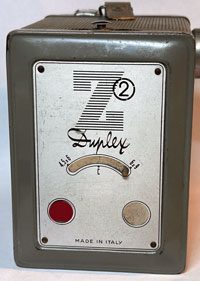
The manual for the use of this camera is found here:- Ferrania Zeta Duplex 2 Manual . It contains explanations in 5 different languages - Italian, French, Engish, German and Spanish.
Choosing picture size. — If the full, 6 × 9 cm. (2¼ × 3¼ in.) size is to be used, the winglets inside the camera are turned backwards on the hopper, where they will be locked by the small side springs. If the 4,5 × 6 cm. (1⅝ × 2¼ in.) size is required, just turn the winglets on to the frame, so as to reduce opening.
There are two red windows on the back. A lever is used to select the correct red window for the negative size required. The lever can be moved to the right (6 × 9 size) or to the left (4.5 × 6), so as to uncover the appropriate red window. If the camera is likely to be exposed to sunlight, the intermediate position C (closed) should be chosen to close both red windows, except when advancing the film in subdued light. Once in position, the format must stay the same for the whole roll.
This camera takes 120 film which is easily available.
Exposure
As the shutter speed is only 1/60s, it is advisable to use a tripod to get clear shake free images. However, holding it against a wall or other solid object would work as well. For quick snapshots, hold it firmly against your body.
If you don't want to bother with an exposure meter, follow the guide shown. It is based on the 'Sunny 16' rule. Film is so forgiving and will produce acceptable results even when overexposed by 2 or 3 stops or underexposed by 1 stop.
The tables assume that the sun is at least 30 degrees above the horizon - that's 10am - 5pm on a summers day (May - August) in the UK.
Remember that the exposure guide in the manual may not be helpful as it is based on the use of old film with a low ISO value.
Using ISO 100/125 film - shutter speed 1/60s
| Weather Conditions | Shadow Detail | Aperture | Exposure |
|---|---|---|---|
 Sunny Snow/Sand | Dark with sharp edges | f/22 | +1 Stop Overexposed Acceptable |
| Sunny | Distinct | f/22 | Good |
 Slight Overcast | Soft around edges | f/16 | Good |
 Overcast | Barely visible | f/11 | Good |
 Heavy Overcast | None | f/11 | -1 Stop Underexposed Acceptable |
 Open Shade /Sunset | None | f/11 | -2 Stops Underexposed Not Acceptable |
Get Film for this camera from Ebay - 120 film