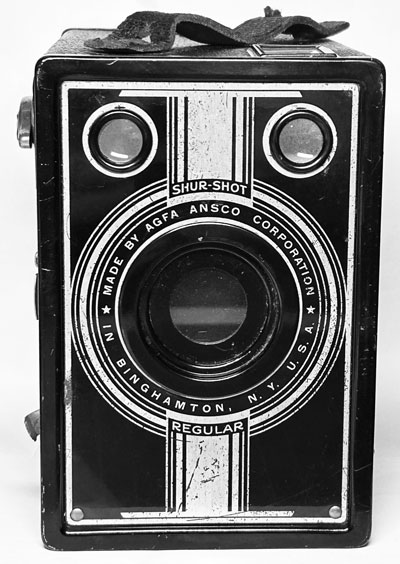
Agfa Ansco Shur-Shot Regular D6
Specification
Art Deco Credentials ⓘ

Bold, geometric cameras from Deco’s golden age


Noteworthy: Distinct Deco elements worth attention
- Produced during the main Art Deco period;
- Geometric Art Deco design on front plate;
- Leather handle/strap.
Specification
| Manufacturer | : | Agfa-Ansco |
|---|---|---|
| Produced | : | 1932-1940 |
| Classification | : | Medium Format |
| Body Type | : | Box |
| Construction | : | Cardboard/Metal |
| Film Type | : | 116 |
| Film Width | : | 70mm |
| Image Size | : | 4¼ x 2½, 2½ x 2⅛ in |
| No. of Images | : | 8/16 |
| Lens Type | : | Meniscus |
| Focus Type | : | Fixed |
| Focal Length | : | 100mm |
| Focus Range | : | 10ft - inf |
| Aperture Type | : | Multihole |
| Aperture | : | f/16, f/22 |
| Shutter Type | : | Rotary |
| Shutter Speeds | : | B,I*(1/60 sec) |
| Size (w x h x d) | : | 90 x 135 x 140 mm |
| Weight | : | 608g |
| * Measured on this camera | ||
Description
The Agfa Ansco Shur Shot series began in 1932 and ended in 1940. Shur Shot cameras originally carried the name Agfa-Ansco in use at that time. Post-1941 models were branded as Ansco alone because of the German connection of Agfa. Although the Agfa Ansco Shur-Shot Regular D6 is a simple camera made from cardboard, wood and metal, it is particularly well made. It is capable of capturing eight 4¼ x 2½ inch exposures or sixteen 2½ x 2⅛ inch exposures on standard no. 116 roll film. This basic box construction hadn't changed much from when box cameras first appeared. The camera is made of a water resistant fiber body covered in black imitation leather, with a metal faceplate. The back is also made of metal. The shutter assembly is supported with a wooded block. There is a diagonal leather handle on the top.
The camera is fitted with a fixed focus lens for taking photos from about 8 feet to infinity. There are two apertures available but only one shutter speed. The glass single meniscus lens is located behind the shutter and aperture to obtain the optimal performance from a simple lens design. The shutter provides a snapshot speed of about 1/60 of a second.

Film advance is by the use of two ruby window on the back door. These ruby windows are used in connection with swinging wings inside the camera and two scribed lines on the ground glass viewfinders.
When the wings are open and clipped back, the image produced on the film is 4¼ x 2½ inch inches. The whole of the viewfinder is used and only lowest ruby window is used to advance the film to the new frame.
When the wings are in place, the image is half that size. Only the area between the scribed lines on the viewfinder is used to frame the picture. The film is advanced so that a number appears in the lower ruby window for the first frame and centre ruby window for the next frame. This is repeated for all of the next 7 numbers giving 16 shots.
It has a metal winding knob. There are two viewfinders for landscape and portrait orientation.
Bulb exposures are achieved by pulling a small tab outwards. This model also includes another tab which allows for the positioning of either a smaller aperture (approximately f/22) or a yellow filter, in front of the main lens. (The filter was intended for black & white photography, e.g. to deepen the tone of blue skies.)
For maintenance, the metal faceplate of the camera can be taken off by lifting tabs away from three small pegs, which gives access to the shutter and viewfinders. As in many box cameras, highly polished steel plates were used for the interior reflective surfaces of the viewfinders instead of mirrors. These seem to stand the test of time better than mirrored glass surfaces.
There is no cable release socket and no tripod mount.

Get a camera like this from Ebay - Agfa-Ansco Shur Shot Regular D6
How to Use
A manual for this camera can be found here:-
Shur-Shot manual.
However, this manual is for the Special version with distance control. Ignore the section on 'Distance Control'.
This camera takes 116 film which is not available anymore except as expired films. This means that the camera needs modification to take 120 film. Modification is fairly straight forward and will easily give 5 'panoramic' exposures producing 2¼ x 4¼ inch negatives. Check out my page on 'Conversion of a 116 camera to take 120 film'.
With modern film, which is sensitive to red light, it is advisable to cover the red windows with black tape. Uncover the windows to wind on, but only in low light conditions.
As the shutter speed is only 1/60s, it is advisable to use a tripod to get clear shake free images. However, holding it against a wall or other solid object would work as well. For quick snapshots, hold it firmly against your body.
If you don't want to bother with an exposure meter, follow the guide shown. It is based on the 'Sunny 16' rule. Film is so forgiving and will produce acceptable results even when overexposed by 2 or 3 stops or underexposed by 1 stop.
There are two aperture settings - f/16(Tab in) and f/22(Tab fully out) There is an intermediate setting which gives a yellow filter at f/16.
The tables assume that the sun is at least 30 degrees above the horizon - that's 10am - 5pm on a summers day (May - August) in the UK.
Remember that the exposure guide in the manual may not be helpful as it is based on the use of old film with a low ISO value.
Using ISO 100/125 film - shutter speed 1/60s
| Weather Conditions | Shadow Detail | Aperture | Exposure |
|---|---|---|---|
 Sunny Snow/Sand | Dark with sharp edges | f/22 | +1 Stops Overexposed Acceptable |
| Sunny | Distinct | f/22 | Good |
 Slight Overcast | Soft around edges | f/16 | Good |
 Overcast | Barely visible | f/16 | -1 Stop Underexposed Acceptable |
 Heavy Overcast | None | f/16 | -2 Stops Underexposed Not Acceptable |
 Open Shade /Sunset | None | f/16 | -3 Stops Underexposed Not Acceptable |
Get Film for this camera from Ebay - 120 film